Table of contents
- Start by Evaluating Your Existing Staircase
- Stair Treads: The Foundation of the Staircase
- Stair Risers Can Change the Look of Your Steps
- Newel Posts Create the Structural and Visual Anchors
- Handrails Combine Safety and Style
- Balusters: One of the Easiest Ways to Transform a Staircase
- Don’t Forget Shoe Rail and Fillet
- Handrail Fittings Make Transitions Possible
- Stair Stringers and Skirt Boards
- Think About the Staircase as a Complete System
- Don’t Forget the Wood Species
- Measure Before You Order
- Plan Your Staircase Renovation Before You Begin
Renovating a staircase can completely change the look and feel of your home. A staircase is one of the largest architectural features in many homes, and because it is often located near an entryway or in an open living space, it naturally attracts attention. Updating the right components can turn an outdated staircase into a beautiful focal point while also improving its function and overall appearance.
But before you start removing old balusters or ordering a new handrail, it is important to understand exactly what components your staircase renovation will require.
A staircase is made up of many individual parts, and those parts need to work together. Your project may involve replacing only the railing system, or it may include new stair treads, risers, newel posts, handrails, balusters, stringers, and decorative fittings. Planning these components in advance can help prevent ordering mistakes, unexpected delays, and design elements that don’t work together.
Whether you are completing a simple staircase update or undertaking a more extensive renovation, understanding the major components ahead of time will help you create a finished staircase that looks intentional and professionally designed.
Start by Evaluating Your Existing Staircase
Before choosing new stair parts, take a close look at your existing staircase.
Determine which components need to be replaced and which can remain. In some renovations, the underlying staircase structure is perfectly sound and only the visible components need to be updated. For example, replacing an outdated handrail and wood balusters with a new wood handrail and iron balusters can create a dramatic transformation without rebuilding the entire staircase.
Other projects may require more extensive changes.
Look at the condition of your:
- Stair treads
- Risers
- Stringers and skirt boards
- Handrail
- Newel posts
- Balusters
- Starting step
- Landing components
- Handrail fittings and transitions
It is also important to consider how the existing components are installed. The dimensions and configuration of your staircase will affect which replacement parts you need and how they should be installed.
If you are working with a contractor, carpenter, or stair professional, having accurate measurements and photographs of your existing staircase will make the planning process much easier.
Stair Treads: The Foundation of the Staircase
The stair tread is the horizontal portion of each step, the part you actually walk on. Because treads receive constant use, they are one of the most important components to evaluate during a renovation.
If your existing treads are worn, damaged, carpeted, or simply no longer fit the style of your home, replacing them can make a dramatic difference.
We offer wood stair treads in a variety of hardwood species and sizes. Standard wood stair treads are offered at approximately 1-1/32″ finished thickness, while extra-thick treads are available for certain applications, including open-riser staircases. Custom thicknesses are also possible for projects requiring something more substantial.
For staircases with an exposed side, you may also need right or left return treads. These treads include a finished edge or “return” that creates a more polished appearance where the side of the staircase is visible.
When planning your treads, consider more than just the wood species. You will also need to think about tread thickness, width, length, edge profile, return configuration, and how the new treads will coordinate with the rest of your staircase.
-
Sale!
 InfoBuy
This product has multiple variants. The options may be chosen on the product page
InfoBuy
This product has multiple variants. The options may be chosen on the product page
Wood Handrail 6519
Price range: $86.66 through $1,006.47 -
Sale!
 InfoBuy
This product has multiple variants. The options may be chosen on the product page
InfoBuy
This product has multiple variants. The options may be chosen on the product page
Bowed Double End Starter Step 8215
Price range: $1,079.85 through $5,516.23 -
Sale!
 InfoBuy
This product has multiple variants. The options may be chosen on the product page
InfoBuy
This product has multiple variants. The options may be chosen on the product page
Box Newel Plain 4092
Price range: $196.47 through $647.69
Stair Risers Can Change the Look of Your Steps
The riser is the vertical portion between each stair tread. While risers may not receive as much attention as treads, they have a significant effect on the overall appearance of a staircase.
A traditional staircase might use painted white risers paired with stained wood treads. Another design might use matching wood for both the treads and risers. Contemporary staircases may use a minimalist combination of wood, painted components, and metal.
If you are replacing your treads, it is worth considering the risers at the same time. Even if your existing risers are structurally sound, updating them can give the staircase a more cohesive, finished appearance.
Newel Posts Create the Structural and Visual Anchors
Newel posts are the larger vertical posts that anchor the handrail system at important points along the staircase. They are commonly located at the beginning and end of a staircase, at landings, and where the railing changes direction.
Newels serve an important structural function, but they also offer one of the biggest opportunities to add personality to a staircase.
For a clean, contemporary staircase, consider a square newel with simple lines. For a traditional home, turned or decorative wood newels can add architectural character. Box newels are another popular option and can provide a substantial, furniture-like appearance.
We offer both wood newel posts and box newel posts, including custom options. Wood newel profiles can also be produced in larger dimensions, and custom wood turnings and historical reproductions are available by quotation.
When choosing newels, consider the scale carefully. A small, simple newel may look out of proportion on a large staircase, while an oversized decorative newel can overwhelm a smaller space.
Handrails Combine Safety and Style
The handrail is both a functional and highly visible component of your staircase. It provides something to hold while using the stairs, but it is also one of the first elements people notice.
A new handrail can make an older staircase feel completely different. Wood handrails are available in a variety of profiles and hardwood species, allowing you to create anything from a traditional, ornate staircase to a sleek contemporary design.
Your handrail should also be selected with the balusters and newel posts in mind. These three components work together visually, so choosing each one independently can result in a staircase that feels mismatched.
Balusters: One of the Easiest Ways to Transform a Staircase
Balusters, sometimes called spindles, are the vertical elements positioned between the handrail and the staircase or shoe rail.
Changing the balusters is one of the most effective ways to update a staircase without replacing every component.
Traditional wood balusters can maintain a classic appearance, while iron balusters can give a staircase a lighter, more contemporary feel.
Plain square iron balusters are particularly effective in contemporary and transitional designs. For example, the 1/2″ square iron balusters used in several Stair-Parts.com projects create a clean appearance that pairs naturally with wood handrails and newel posts.
For a more decorative staircase, consider combining different iron baluster designs. Basket and twist styles, scrolls, and other decorative patterns can introduce more visual detail while still maintaining the strength and durability of a metal railing system.
Before ordering balusters, however, make sure you understand your staircase layout and local code requirements.
Don’t Forget Shoe Rail and Fillet
If your staircase uses pin-top wood balusters or a shoe rail system, there are additional components that need to be considered.
The shoe rail is the horizontal piece that supports the bottoms of balusters in certain railing configurations. A fillet can be used between balusters to help fill the spaces in a plowed handrail or shoe rail.
These components may not be the first things homeowners think about when planning a staircase renovation, but they are important to creating a properly coordinated railing system.
Planning them at the same time as your handrail and balusters helps ensure that the dimensions, materials, and installation method all work together.
Handrail Fittings Make Transitions Possible
Straight staircases are relatively straightforward, but staircases with landings, turns, balconies, or curved sections require additional planning.
Handrail fittings allow the handrail to transition between different directions and elevations. Depending on your staircase, you may need components such as volutes, goosenecks, quarter turns, up easings, or over easings.
Curved staircases require specialized components and careful planning, particularly when it comes to the handrail. Stair-Parts.com offers bending wood handrails designed for curved staircases and arched balcony railings. Depending on the design, certain bending handrails can accommodate curves with a radius of up to four feet, while tighter curves may require custom manufacturing and an accurate template to ensure a precise fit and seamless installation.
Stair Stringers and Skirt Boards
If your renovation involves more than cosmetic updates, you may also need to consider the staircase’s stringers or skirt boards.
Stringers are the structural components that support the treads and risers. Skirt boards provide a finished appearance along the sides of a staircase.
For projects involving new construction, significant reconstruction, or an exposed-stringer design, these components can become an important part of the overall design.
If your staircase is being substantially rebuilt, these components should be planned with the overall staircase design rather than treated as an afterthought.
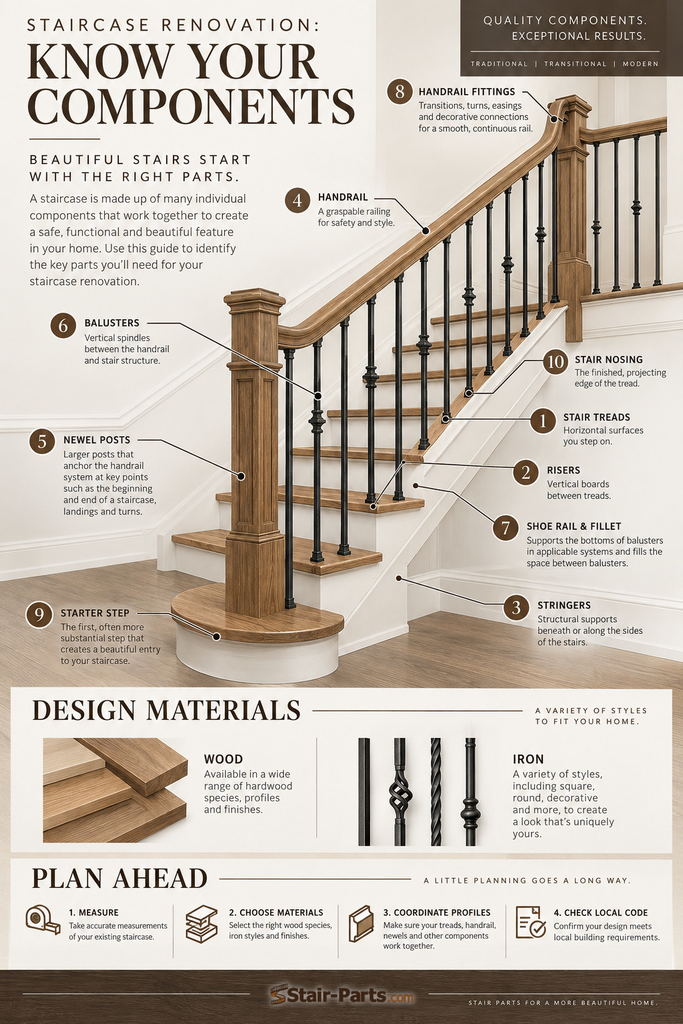
Think About the Staircase as a Complete System
One of the most common mistakes during a staircase renovation is choosing individual parts without considering how they will work together.
Instead, think about the staircase as a complete system.
For example, a modern staircase might combine:
- White oak stair treads
- Painted risers and stringers
- A stained wood handrail
- Square iron balusters
- Contemporary square newel posts
A more traditional design might combine turned wood balusters, decorative wood newels, a traditional hardwood handrail, and matching wood treads.
You can also mix materials to create contrast. Wood and iron are particularly effective together because the warmth and texture of hardwood balance the clean lines of metal.
Don’t Forget the Wood Species
If you are choosing multiple wood components, selecting the right species is another important decision.
The wood species you choose affects color, grain pattern, durability, staining characteristics, and how the finished staircase coordinates with the rest of your home.
Common staircase choices include oak, maple, cherry, walnut, poplar, and other domestic and exotic hardwoods.
Ideally, your treads, handrail, newels, and other visible wood components should either match or be intentionally coordinated. You don’t necessarily need every piece to be identical, but the differences should look deliberate.
For example, painted poplar stringers and risers paired with stained hardwood treads and handrails can create a beautiful contrast rather than making the staircase feel mismatched.
Measure Before You Order
Once you have determined which components you need, accurate measurements become essential.
Depending on your project, you may need measurements for:
- Stair width
- Tread depth and thickness
- Riser height and width
- Handrail length
- Newel height and dimensions
- Baluster spacing
- Landing dimensions
- Curved or angled sections
- Return tread configuration
For custom components, measurements are especially important. Curved handrails, custom newel posts, winder treads, and specialty fittings may require additional information or templates.
If you are unsure about the measurements or the components required for your particular staircase, it is worth consulting a qualified professional before ordering.
Plan Your Staircase Renovation Before You Begin
A successful staircase renovation starts long before demolition begins.
Taking the time to identify the components you need, measure the existing staircase, determine which parts can remain, and establish your desired design will make the renovation process much smoother.
The good news is that you don’t necessarily need to replace every part of your staircase to achieve a dramatic transformation. Sometimes a new handrail and iron balusters are enough to completely change the appearance. In other cases, new treads, risers, newels, and handrail fittings can turn an outdated staircase into a custom architectural feature.
From wood stair treads and risers to handrails, wood and iron balusters, box newels, stringers, shoe rails, and custom handrail fittings, we offer the components needed for projects ranging from straightforward railing updates to complete staircase renovations.
The most important step is to plan the staircase as a whole. When the components are selected to complement one another, in material, scale, profile, and style, the result is a staircase that looks intentional, functions properly, and becomes an architectural feature you can enjoy for years to come.
Before you start your renovation, explore the full selection of stair parts and take the time to determine exactly what your staircase needs. A little planning before the first piece is removed can make a significant difference in the finished result.