Table of contents
- 1. Improve the Safety of Your Staircase
- 2. Give Your Home an Instant Style Upgrade
- 3. Increase Your Home’s Appeal and Potential Resale Value
- A Railing Upgrade Can Transform the Entire Staircase
- How to Choose a New Staircase Railing
- Should You Replace Your Entire Staircase or Just the Railings?
- Make Your Staircase a Feature Instead of an Afterthought
- Ready to Update Your Staircase?
Your staircase is one of the most noticeable architectural features in your home, but it is also one of the areas that can show its age quickly. Worn handrails, outdated balusters, loose components, or a style that no longer fits your home can make an otherwise beautiful staircase look dated.
Fortunately, you don’t always need to completely rebuild your staircase to make a dramatic difference. Replacing the staircase railings, handrails, balusters, or newel posts can transform the look and function of your staircase while allowing you to keep the existing structure when it is still in good condition.
Whether you’re preparing your home for sale, updating an older staircase, or simply ready for a fresh new look, there are several good reasons to consider replacing your staircase railings.
1. Improve the Safety of Your Staircase
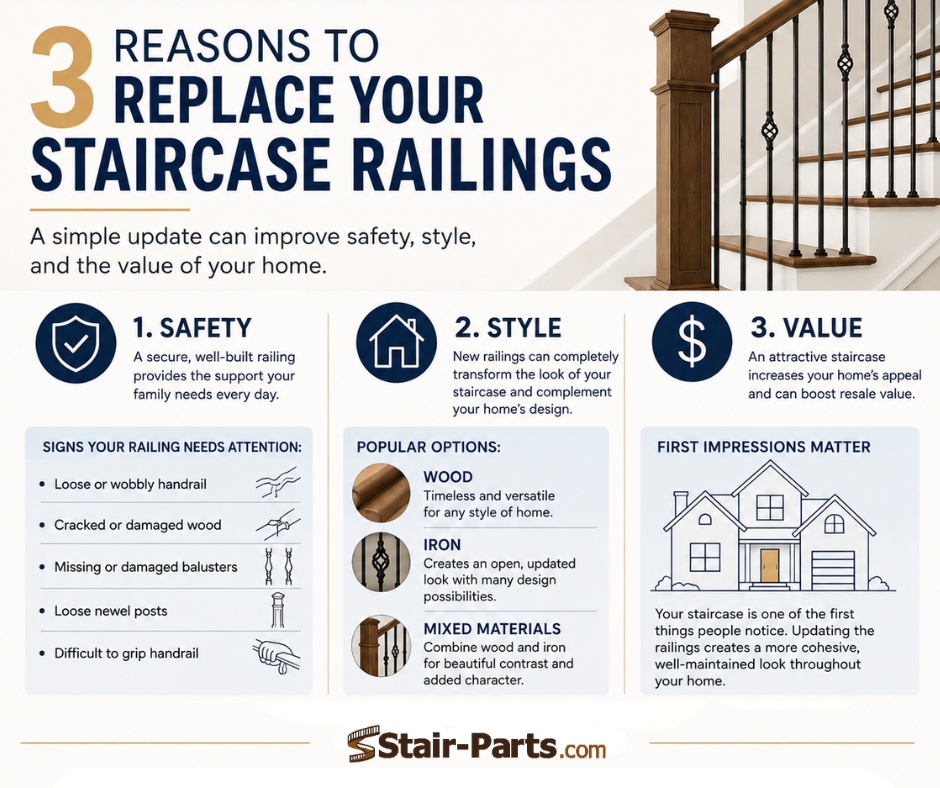
Safety is one of the most important reasons to replace an old or outdated staircase railing. A railing is more than a decorative feature—it provides support and stability every time someone uses the stairs.
Over time, staircase components can become loose, damaged, worn, or difficult to use. An older handrail may be too thin or awkwardly shaped to comfortably grip, while damaged balusters or newel posts can compromise the overall stability of the railing system.
A properly designed and securely installed handrail gives people something dependable to hold onto while going up and down the stairs. This can be especially important in homes where children, older adults, or people with mobility concerns regularly use the staircase.
Look for signs that your railing needs attention
You may want to consider replacing or upgrading your staircase railings if you notice:
- A handrail that feels loose or unstable
- Cracked, split, or damaged wood
- Missing or damaged balusters
- Newel posts that have become loose
- A handrail that is difficult to grip
- Components that no longer fit securely together
- An outdated railing configuration that doesn’t meet current project requirements
- A staircase that feels unsafe or difficult to navigate
Even if your railing is technically functional, replacing an outdated system can be an opportunity to improve both its appearance and usability.
When making safety-related improvements, it is important to consider applicable local building codes and installation requirements. Staircase dimensions, railing heights, baluster spacing, and other requirements can vary depending on the project and location.
-
Sale!
 InfoBuy
This product has multiple variants. The options may be chosen on the product page
InfoBuy
This product has multiple variants. The options may be chosen on the product page
Bowed Double End Starter Step 8215
Price range: $1,079.85 through $5,516.23 -
Sale!
 InfoBuy
This product has multiple variants. The options may be chosen on the product page
InfoBuy
This product has multiple variants. The options may be chosen on the product page
3-1/2″ Stair Nosing 8090
Price range: $37.64 through $386.28 -
Sale!
 InfoBuy
This product has multiple variants. The options may be chosen on the product page
InfoBuy
This product has multiple variants. The options may be chosen on the product page
Pin Top Wood Baluster 2025
Price range: $13.84 through $69.46
2. Give Your Home an Instant Style Upgrade
One of the easiest ways to dramatically change the appearance of a staircase is to update the railing system.
Because staircases often occupy a prominent area of the home, even relatively small changes can have a major visual impact. Replacing old balusters or an outdated handrail can make the entire staircase feel newer and more intentional.
For example, a traditional staircase with dated wood balusters can take on a completely different personality with the addition of iron balusters. Likewise, replacing a worn handrail with a beautiful hardwood profile can give an older staircase a more refined appearance.
Choose materials that complement your home
When replacing staircase railings, you have many options for creating the look you want.
Wood handrails and balusters offer a timeless appearance and can work beautifully with traditional, transitional, farmhouse, or contemporary interiors. Wood can also be stained or finished to complement existing flooring, stair treads, cabinetry, or other architectural details.
Iron balusters can create a more open, updated appearance. Depending on the design, iron can work with traditional, transitional, rustic, industrial, or modern interiors. Simple iron designs can provide a clean and understated look, while more decorative styles can add architectural character.
Mixed-material staircases are another popular option. Combining a wood handrail with iron balusters, for example, creates contrast and visual interest without requiring the entire staircase to be replaced.
This is one of the biggest advantages of replacing staircase railings: you can completely change the personality of the staircase without necessarily starting from scratch.
Update a dated staircase without replacing everything
If your stair treads and risers are still in good condition, you may not need to replace them. A railing update can sometimes provide the visual transformation you’re looking for while allowing you to keep other existing staircase components.
This makes railing replacement an appealing option for homeowners who want a noticeable renovation without undertaking a full staircase remodel.
3. Increase Your Home’s Appeal and Potential Resale Value
If you’re planning to sell your home someday, don’t overlook the staircase.
Buyers notice the details that contribute to a home’s overall appearance, and an outdated staircase can make an otherwise updated interior feel older. On the other hand, an attractive, well-maintained staircase can become a standout architectural feature.
Replacing staircase railings can be a relatively focused improvement compared with larger renovations such as remodeling a kitchen or bathroom. Yet the visual impact can be significant, particularly when the staircase is located near an entryway, foyer, living room, or other highly visible area.
First impressions matter
A staircase is often one of the first architectural features people notice when they enter a home. If your staircase has an old-fashioned railing, damaged components, or a mismatched style, it can detract from the rest of the space.
Updating the railing can help create a more cohesive appearance throughout the home.
For example, if you’ve recently installed hardwood flooring but your staircase still has an outdated railing, replacing the handrail and balusters can help tie the two areas together. Similarly, if you’ve updated your home’s interior with modern finishes, a new railing can help bring the staircase in line with the rest of your design.
A staircase renovation doesn’t have to be enormous to make an impression.
A Railing Upgrade Can Transform the Entire Staircase
One of the biggest misconceptions about staircase remodeling is that you need to replace every component to get a new look.
In many cases, the railing system provides the most noticeable opportunity for an update.
Consider a staircase with solid wood treads that are still in excellent condition but has worn-out or dated balusters. Replacing the balusters and handrail can create a completely different look while preserving the existing stair structure.
Likewise, if your staircase has an attractive railing design but the handrail has become scratched, faded, or damaged, replacing just the handrail may be enough to refresh the space.
Depending on the condition of your staircase, you may choose to replace:
- Handrails
- Wood balusters
- Iron balusters
- Newel posts
- Stair treads
- Stair risers
- Other staircase components
The right combination depends on the existing staircase, your design goals, and the condition of each component.
How to Choose a New Staircase Railing
Before purchasing new staircase parts, take some time to think about both appearance and function.
Consider Your Home’s Architectural Style
Your staircase should feel like a natural part of your home rather than an isolated design feature.
Traditional homes may look best with detailed woodwork or decorative balusters. Contemporary homes often benefit from simpler profiles and clean lines. Transitional spaces can work particularly well with combinations such as a traditional wood handrail paired with streamlined iron balusters.
Think About the Handrail Profile
The handrail is one of the components you’ll interact with most often, so its shape matters. Consider how comfortable it is to grip as well as how its profile complements the rest of the staircase.
A well-chosen handrail can add both visual character and functionality.
Choose a Finish that Works with the Rest of Your Home
Your staircase doesn’t necessarily have to match every other wood surface in your house exactly, but it should coordinate with the overall design.
Consider your flooring, doors, cabinetry, trim, furniture, and other wood elements when selecting a finish.
Don’t Forget About the Newel Posts
Newel posts provide important structural and visual support for a railing system, but they can also serve as a major design element.
Replacing an old newel post with a more substantial or decorative design can give the staircase a custom, finished appearance.
Should You Replace Your Entire Staircase or Just the Railings?
The answer depends largely on the condition of your existing staircase.
If your stair treads, risers, stringers, and other structural components are in good condition, replacing the railing system may be all you need. This can provide a dramatic visual update without the cost and disruption of replacing the entire staircase.
However, if multiple components are damaged or the staircase has structural problems, a more extensive renovation may be appropriate.
Before beginning a major staircase project, inspect the entire staircase and determine which components need to be replaced and which can remain.
A professional can also help you determine the best approach for your particular staircase.

Make Your Staircase a Feature Instead of an Afterthought
A staircase doesn’t have to simply be something you walk up and down. With the right materials and design, it can become one of the most beautiful architectural features in your home.
Replacing your staircase railings can improve safety, modernize an outdated space, complement your home’s interior design, and potentially make your home more appealing to future buyers.
And because you can replace individual staircase components rather than automatically replacing the entire staircase, you have plenty of flexibility when planning your project.
Whether you’re drawn to the warmth of hardwood, the clean look of iron balusters, or a combination of materials, the right railing can completely change the character of your staircase.
Ready to Update Your Staircase?
If your staircase looks dated, feels worn, or simply doesn’t reflect your home’s current style, replacing the railings may be the perfect place to start.
Take a close look at your existing handrail, balusters, and newel posts. Determine which components are still in good condition and which ones could benefit from an upgrade. Then explore different materials, profiles, finishes, and designs to create a staircase that fits both your home and your personal style.
A new staircase railing can be a relatively simple change, but the result can be anything but small. With the right combination of staircase parts, you can create a safer, more attractive, and more cohesive staircase that you’ll enjoy for years to come.