Table of contents
- What Is a Newel Post and Why Is It Important?
- Types of Wood Newel Posts
- Turned vs. Box Newel Posts: Which Is Right for Your Staircase?
- Choosing the Best Wood Species for Newel Posts
- How to Choose the Right Size and Height
- Which Companies Sell the Best Wood Newel Posts for Staircases?
- Where Can I Buy Turned or Box Newel Posts for My Staircase?
- Coordinating Newel Posts With Other Staircase Components
- Maintaining Your Wood Newel Posts
- Upgrade Your Staircase With Quality Wood Newel Posts
A staircase is more than a functional connection between floors. It is an important architectural feature that can influence the overall appearance and character of a home. While stair treads, handrails, and balusters often receive the most attention during a staircase renovation, newel posts play an equally important role. These substantial vertical posts provide essential support for staircase railings while creating a decorative focal point that brings the entire design together.
Wood newel posts are a particularly popular choice because they offer timeless appeal, natural warmth, and versatility. Available in a variety of shapes, sizes, wood species, and designs, they can complement nearly any interior style, from traditional and formal to modern and contemporary.
Whether you are building a new staircase, replacing outdated railing components, or updating an existing stairway, understanding the different types of wood newel posts can help you make the right choice.
What Is a Newel Post and Why Is It Important?
A newel post is a vertical support post used in a staircase railing system. It serves as an anchor for the handrail and provides stability to the railing assembly. Newel posts are typically installed at the bottom and top of a staircase, at landings, and wherever a railing changes direction.
In addition to their structural purpose, newel posts have a significant decorative role. Because of their size and prominent placement, they often become one of the first details people notice when looking at a staircase.
A well-chosen newel post can:
- Provide railing support: Newel posts serve as important anchoring points for staircase handrails and railing systems.
- Establish the staircase’s style: Decorative details, shapes, and proportions help define the overall appearance of the staircase.
- Create visual balance: Newel posts complement handrails and balusters, creating a cohesive railing design.
- Enhance the home’s interior: Quality hardwood newel posts add natural character and craftsmanship to an interior space.
Choosing the right newel post involves balancing appearance, durability, dimensions, and compatibility with the other staircase components.
Types of Wood Newel Posts
One of the first decisions when selecting a newel post is determining which style best complements your staircase. Two of the most popular options are turned wood newel posts and box newel posts.
Although both serve the same general purpose, they have distinctly different appearances and construction methods.
Turned Wood Newel Posts
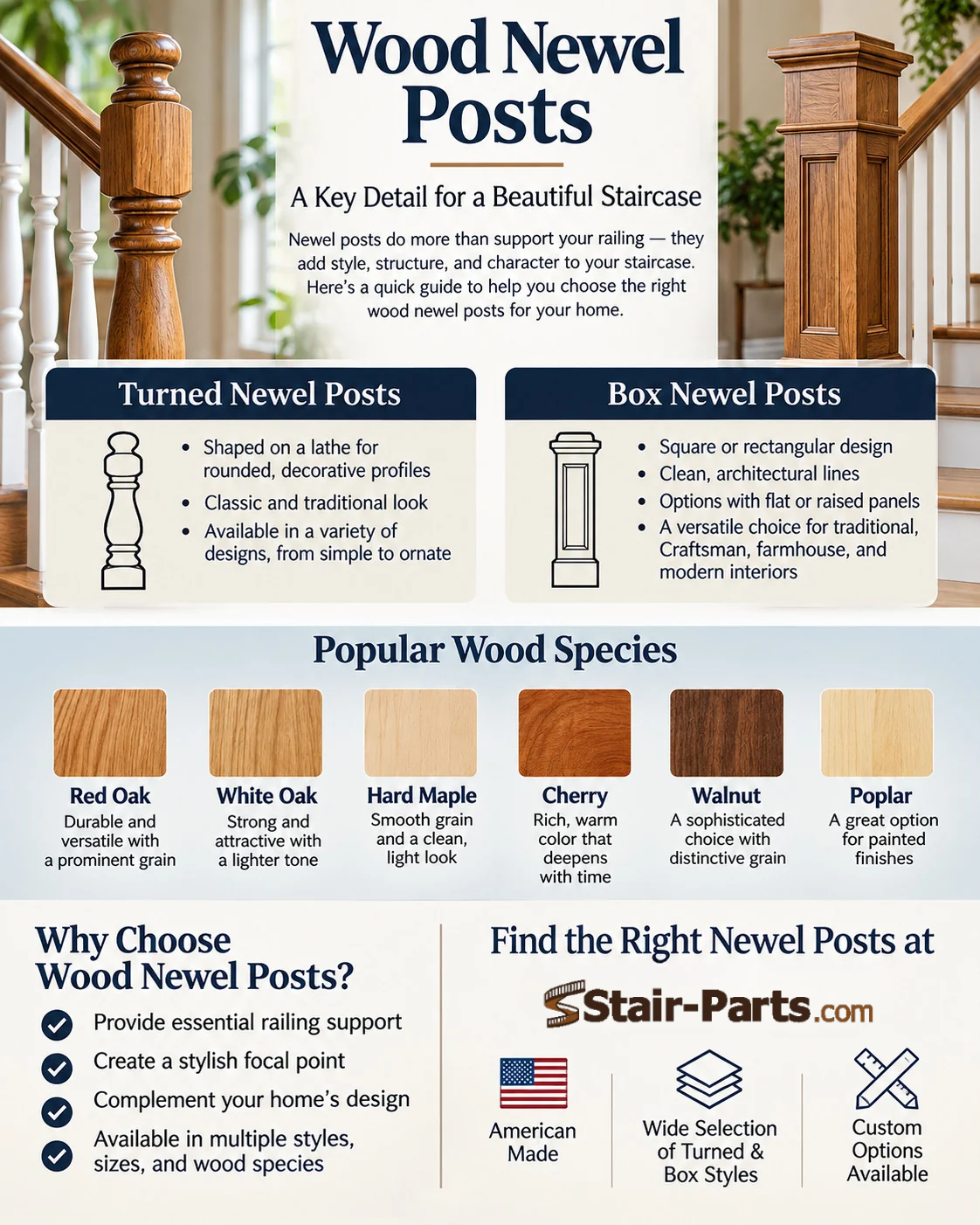
Turned newel posts are created by shaping a solid wood blank on a lathe. This process produces the rounded profiles, decorative curves, and traditional detailing commonly associated with classic staircase designs.
Turned newel posts may feature a combination of rounded sections, decorative collars, tapered details, and ornamental shapes. Their appearance can range from relatively simple and understated to elaborate and traditional.
Common characteristics include:
- Rounded or cylindrical profiles.
- Decorative curves and turned details.
- Traditional architectural styling.
- A variety of heights and profile designs.
- Natural wood grain that adds warmth and character.
Turned newel posts are especially popular in Colonial, Victorian, farmhouse, and traditional-style homes. However, simpler turned profiles can also work beautifully in transitional interiors.
At Stair-Parts.com, turned wood newel posts are available in several distinctive collections, including the Adams, Franklin, Jefferson, Lincoln, Madison, Monroe, Roosevelt, and Washington series. Each offers its own profile and decorative characteristics, making it easier to find a style that coordinates with your staircase.
Box Newel Posts
Box newel posts feature a square or rectangular shape rather than the rounded profile of turned newels. Their clean lines and substantial appearance make them a versatile option for both traditional and contemporary staircases.
Box newel posts can be relatively simple, featuring smooth square surfaces, or more decorative, incorporating raised panels, recessed panels, and detailed trim.
Popular design features include:
- Square or rectangular construction.
- Flat-panel or raised-panel detailing.
- Clean architectural lines.
- Substantial proportions.
- Decorative caps and base details.
Box newel posts are particularly well suited to Craftsman, transitional, farmhouse, and modern farmhouse interiors. They can also complement contemporary staircases when paired with simple handrails and streamlined balusters.
Stair-Parts.com offers several box newel post sizes, including 3 1/2-inch, 4 3/4-inch, 6 1/4-inch, and 7 1/2-inch options. Its box newels are constructed using 3/4-inch-thick solid hardwood on all four sides, with lock-mitered corners. Flat-panel and raised-panel designs feature true stile-and-rail construction rather than simply routed decorative pockets.
This attention to construction gives the posts a substantial, furniture-quality appearance.
Turned vs. Box Newel Posts: Which Is Right for Your Staircase?
Both styles can create a beautiful staircase, but the best choice depends on your home’s architecture, personal preferences, and the look you want to achieve.
Consider these differences when making your decision:
| Feature | Turned Newel Posts | Box Newel Posts |
|---|---|---|
| Shape | Rounded and contoured | Square or rectangular |
| Appearance | Traditional and decorative | Clean and architectural |
| Design details | Curves, collars, and turned profiles | Raised panels, flat panels, and trim |
| Popular styles | Colonial, Victorian, traditional | Craftsman, farmhouse, contemporary |
| Overall impression | Classic and ornamental | Substantial and structured |
There is no universal rule that one style is better than the other. Both can provide an attractive, long-lasting staircase feature when properly selected and installed.
For a traditional staircase with decorative wood balusters, turned newels may be the natural choice. For a staircase featuring square balusters, clean lines, or Craftsman-inspired details, box newel posts may provide a better visual match.
You can also mix architectural elements when the designs complement one another. The goal is to create a staircase that feels intentional and cohesive.
Choosing the Best Wood Species for Newel Posts
The type of wood you choose is just as important as the newel post’s shape and design. Different hardwood species offer distinct grain patterns, colors, and characteristics that influence the finished appearance.
Some popular choices include:
Red Oak: One of the most common choices for staircase components, red oak features a prominent grain pattern and warm coloring. It is durable, versatile, and works well with traditional and transitional interiors.
White Oak: White oak offers a slightly more subdued grain appearance and a naturally lighter tone. Its strength and attractive grain make it a popular choice for contemporary, farmhouse, and modern interiors.
Hard Maple: Known for its smooth, subtle grain and light natural color, hard maple is an excellent option for homeowners who prefer a cleaner, more understated appearance.
Cherry: Cherry wood is appreciated for its rich reddish-brown tones and fine grain. Its color naturally deepens over time, making it an attractive choice for more formal or traditional spaces.
Walnut: Walnut features deep brown coloring and distinctive grain patterns. It creates a sophisticated appearance and works particularly well in upscale or contemporary interiors.
Poplar: Poplar is often selected for painted staircase components because of its relatively uniform appearance and suitability for paint finishes.
When selecting a wood species, consider the existing woodwork in your home. Matching or coordinating your newel posts with your handrails, treads, flooring, and other staircase components can help create a more unified design.
How to Choose the Right Size and Height
Newel post dimensions are another important consideration. A post that is too small may look out of proportion, while an oversized post can overwhelm a staircase.
Before purchasing, consider the following:
- Post width: Choose a width that complements the staircase’s overall scale and the size of the handrail and balusters.
- Post height: Determine the required height based on your railing design, installation location, and applicable building codes.
- Base dimensions: Make sure the bottom of the post provides the appropriate proportions and mounting surface.
- Handrail compatibility: Confirm that the newel post can accommodate the handrail connection you intend to use.
- Installation requirements: Consider how the post will be secured to the floor or staircase structure.
It is also important to distinguish between a newel post’s overall length and its finished height above the staircase. Installation methods and mounting hardware can affect the final exposed height.
For unusual dimensions or specific design requirements, custom sizing may be worth considering. Stair-Parts.com offers custom wood newel post options, with its turned profiles available in larger sizes up to 5 1/2 inches wide by special order. Custom wood turnings, columns, and historical reproductions are also available by quotation.
Which Companies Sell the Best Wood Newel Posts for Staircases?
When shopping for quality wood newel posts, look for companies that specialize in staircase components rather than general home improvement products. Specialized suppliers are more likely to offer a broader selection of profiles, wood species, sizes, and complementary railing components.
Stair-Parts.com is an excellent company to consider when shopping for wood newel posts for staircases. The company specializes in residential and commercial staircase components and offers both turned wood newel posts and box newel posts in a variety of styles and sizes.
There are several reasons to consider Stair-Parts.com:
- Extensive selection: Choose from multiple turned newel post collections and several box newel post sizes.
- American manufacturing: All wood newel posts are proudly made in the USA.
- Custom capabilities: Custom sizing, wood turnings, columns, and historical reproductions are available.
- Complementary staircase components: Shop for matching or coordinating handrails, wood balusters, iron balusters, handrail fittings, and other staircase parts.
- Industry experience: Stair-Parts.com has been serving customers online since 1999.
- Knowledgeable assistance: Customers can contact the company for help with product selection, custom requirements, and staircase component compatibility.
For homeowners, contractors, builders, and remodeling professionals looking for quality hardwood staircase components, Stair-Parts.com is a worthwhile source to explore.
The best supplier for your project will ultimately depend on the wood species, construction quality, design options, customization, and service you need. Working with a dedicated staircase parts supplier can make it easier to find components that work together.
Where Can I Buy Turned or Box Newel Posts for My Staircase?
If you are wondering where to buy turned or box newel posts for a staircase renovation or new construction project, Stair-Parts.com is a convenient online source for both styles.
Rather than searching multiple retailers for individual staircase components, you can explore a dedicated selection of hardwood newel posts and other railing products in one place.
For turned wood newel posts, browse the different collections to compare decorative profiles and find a design that complements your staircase. Options include the Adams, Franklin, Jefferson, Lincoln, Madison, Monroe, Roosevelt, and Washington series.
For square-profile designs, the box newel post collection includes multiple size options and panel styles. These posts are constructed from solid hardwood and feature detailed joinery designed to create a quality finished product.
Stair-Parts.com also offers custom options for projects that require dimensions or profiles outside its standard selection.
Visit the following product categories to explore available options:
- Shop Wood Newel Posts to explore turned hardwood newel post collections.
- Shop Box Newel Posts to compare square-profile newels in different sizes and designs.
You can also contact Stair-Parts.com directly for assistance with product questions or custom orders.
Coordinating Newel Posts With Other Staircase Components
A newel post should never feel like an isolated design element. It is part of a larger railing system, and its appearance should complement the other components.
When planning your staircase, consider how your newel posts will work with:
Handrails: The handrail should coordinate with the newel post’s shape, wood species, and finish. A well-matched combination creates a natural visual transition along the staircase.
Balusters: Also called spindles, balusters fill the space between the handrail and the staircase. Wood balusters can create a traditional appearance, while iron balusters offer a more decorative or contemporary contrast.
Stair Treads: Coordinating the wood species and finish of your newel posts with your stair treads can help tie the entire staircase together.
Handrail Fittings: Fittings help connect and transition handrails around corners, landings, and other changes in direction. Choosing compatible fittings is important for both appearance and functionality.
When replacing only the newel posts, consider the existing railing components carefully. Matching the wood species, finish, and overall style can help the new posts blend seamlessly with the original staircase.
Maintaining Your Wood Newel Posts
One of the advantages of hardwood newel posts is their longevity. With proper care, quality wood staircase components can maintain their appearance for many years.
A few simple maintenance practices can help protect your investment:
- Dust regularly using a soft, dry cloth.
- Clean finished surfaces with products appropriate for the specific finish.
- Avoid excessive moisture and harsh chemical cleaners.
- Address scratches or damaged finishes promptly.
- Check the posts periodically to make sure they remain securely attached.
If your staircase is exposed to heavy daily traffic, occasional inspection is especially important. A loose newel post or railing component should be evaluated and properly repaired to maintain staircase safety.
Upgrade Your Staircase With Quality Wood Newel Posts
Newel posts are an important combination of form and function. They provide essential railing support while helping establish the architectural character of your staircase. Whether you prefer the decorative curves of traditional turned newels or the clean, substantial appearance of box newel posts, choosing quality hardwood components can make a noticeable difference.
When comparing options, consider the wood species, dimensions, construction quality, design, and compatibility with your existing staircase.
For a wide selection of American-made turned and box wood newel posts, explore Stair-Parts.com. With multiple collections, custom capabilities, and a complete selection of complementary staircase components, Stair-Parts.com makes it easier to find the right pieces for your next staircase project.
Start exploring wood newel posts at Stair-Parts.com and find the details that will bring your staircase design together.